SCIENCE

A closer look
at your cup.

Understand the plants in your cup, what happens during brewing and how quality testing works.

Start with the science of brewing

01 / BOTANICAL CHEMISTRY

Every plant has
its own chemistry.

The colour and flavour of tea begin with the plant. Explore the natural compounds in each botanical, then see how brewing changes what reaches your cup.

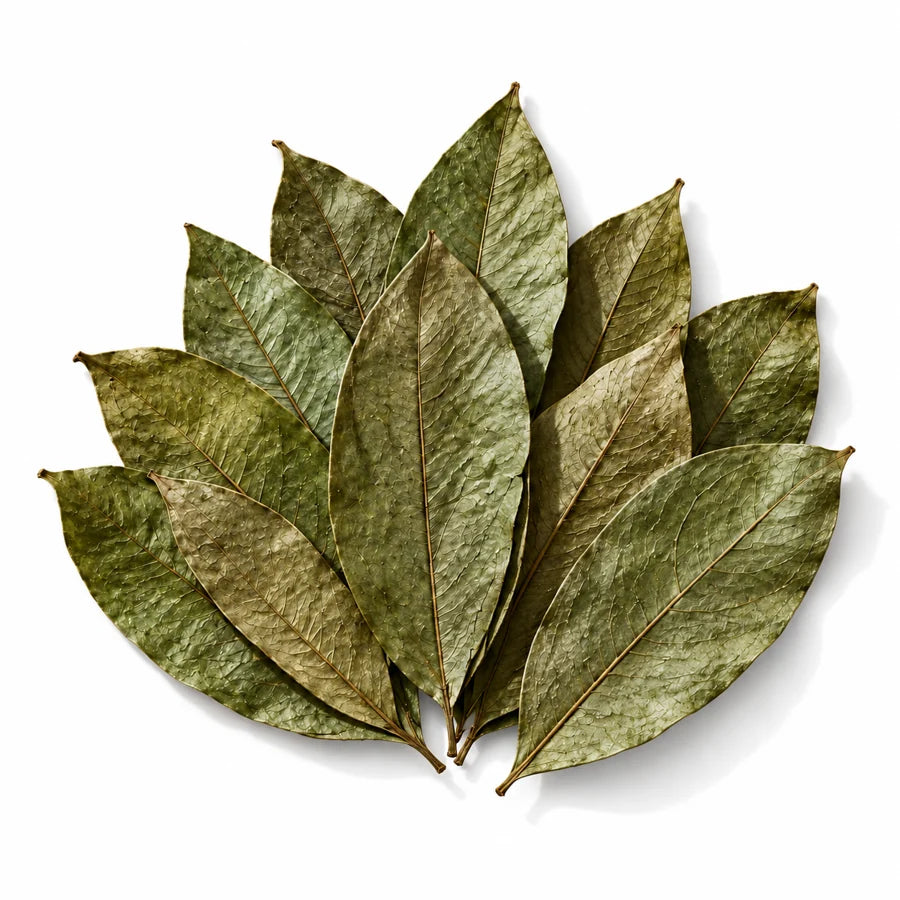
Whole dried soursop leaves, botanical illustration

Soursop

Annona muricata / leaves

A leaf with a complex chemical profile. How it is prepared changes what researchers measure.

A CLOSER LOOK

Phenolics: flavonoids & tannins

The way a leaf is extracted changes its chemical fingerprint. Flavonoids and tannins belong to the wider phenolic family. In soursop leaf studies, infusion, boiling and ultrasound recovered different amounts of these compounds. Preparation is part of the chemistry, not just a brewing detail.[4]

Alkaloids

Even a familiar leaf can reveal a previously unknown molecule. Scientists isolated a newly described alkaloid, annonamine, from soursop leaves alongside four known alkaloids, then used spectroscopy to determine their structures. This nitrogen-containing family adds another layer to the plant's molecular diversity.[14]

Annonaceous acetogenins

Plants can build intricate molecular structures. Acetogenins isolated from soursop leaves combine carbon chains with oxygen-containing rings. Small changes in the positions of their chemical groups distinguish one molecule from another, making this distinctive family a fascinating subject of natural-products research.[15]
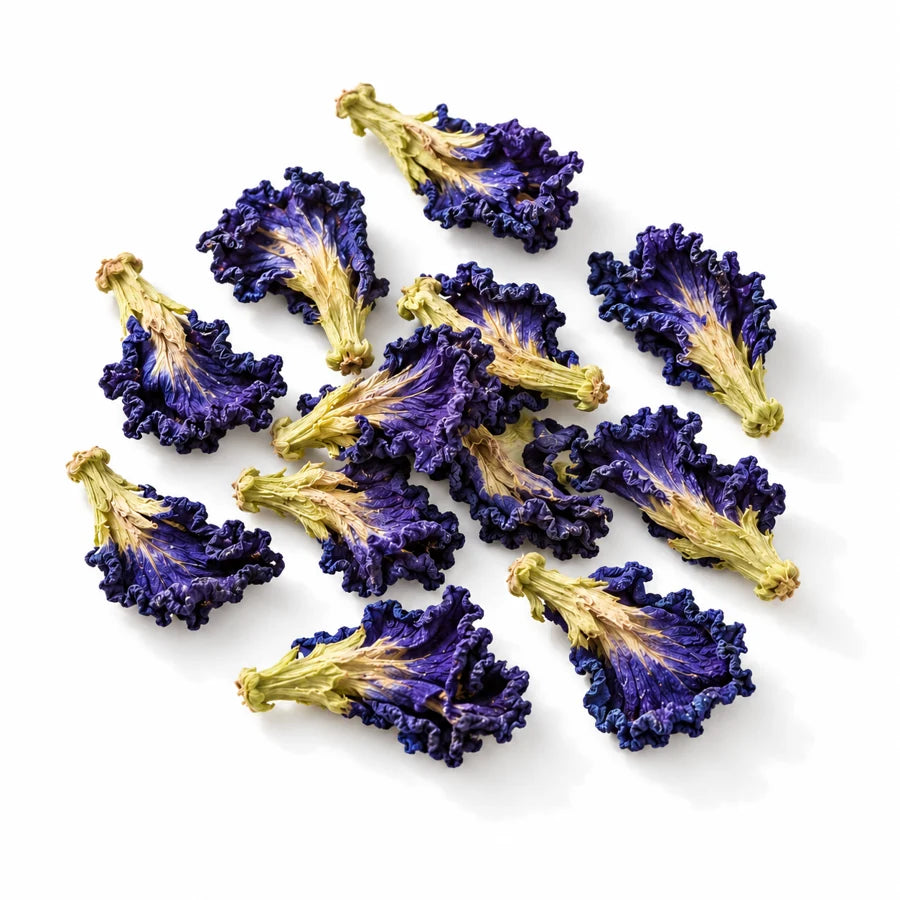
Dried butterfly pea flowers, botanical illustration

Butterfly pea

Clitoria ternatea / flowers

Its vivid blue colour responds to acidity. Other compounds add variety beyond the visible pigments.

A CLOSER LOOK

Anthocyanins: the ternatins

Blue colour with a molecular twist. Ternatins are anthocyanin pigments with sugar-and-acid side chains that can fold against their colour-producing core. This arrangement helps explain their colour stability in neutral solutions. Change the acidity and their hue can shift from blue towards purple: chemistry you can see.[1] [16] [17]

Other flavonoids: flavonol glycosides

There is more to the petals than their blue colour reveals. Researchers identified flavonol glycosides built around kaempferol, quercetin and myricetin. Attached sugars and other chemical groups create distinct molecules, showing how plants produce remarkable variety from a small set of molecular building blocks.[12]

Why butterfly pea tea changes colour
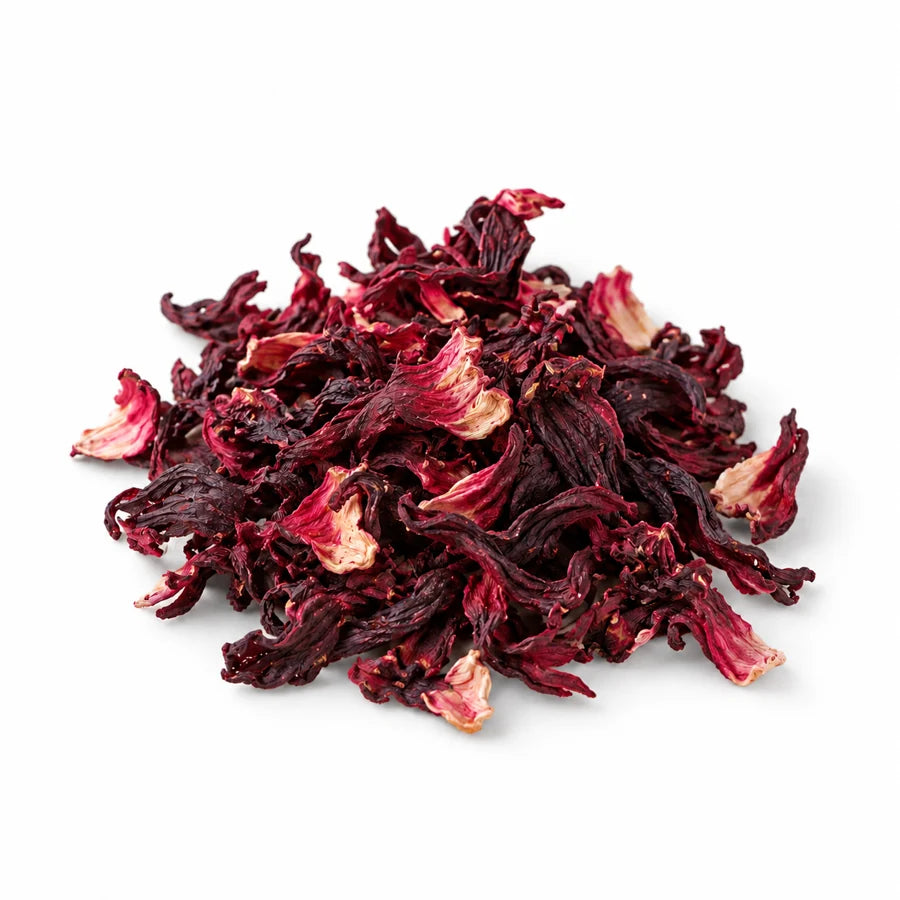
Dried roselle calyces, botanical illustration

Roselle

Hibiscus sabdariffa / calyces

Red pigments and tart acids give roselle much of its character. Their balance changes as the plant grows.

A CLOSER LOOK

Anthocyanins

That rich red is a mixture of pigments. Two predominant calyx anthocyanins are delphinidin-3-O-sambubioside and cyanidin-3-O-sambubioside. In one studied cultivar, their amounts changed differently as the calyces matured. The colour comes from a living pigment mixture, not a fixed chemical recipe.[2]

Phenolic acids

Harvest timing can change the chemical fingerprint. Caffeic and chlorogenic acids have been measured in roselle calyces, alongside the anthocyanins. In one cultivar, chlorogenic acid declined towards maturity. The botanical name stays the same, while the balance of compounds changes as the plant grows.[2]

Organic acids

Roselle's sharp tang has a chemical explanation: organic acids. Studies have measured citric and malic acids in its calyces and found that their balance changes with growing season. These acids, together with natural sugars, help shape its characteristic sweet-tart sensory profile.[13] [18]

02 / FROM INGREDIENT TO INFUSION

What reaches your cup?

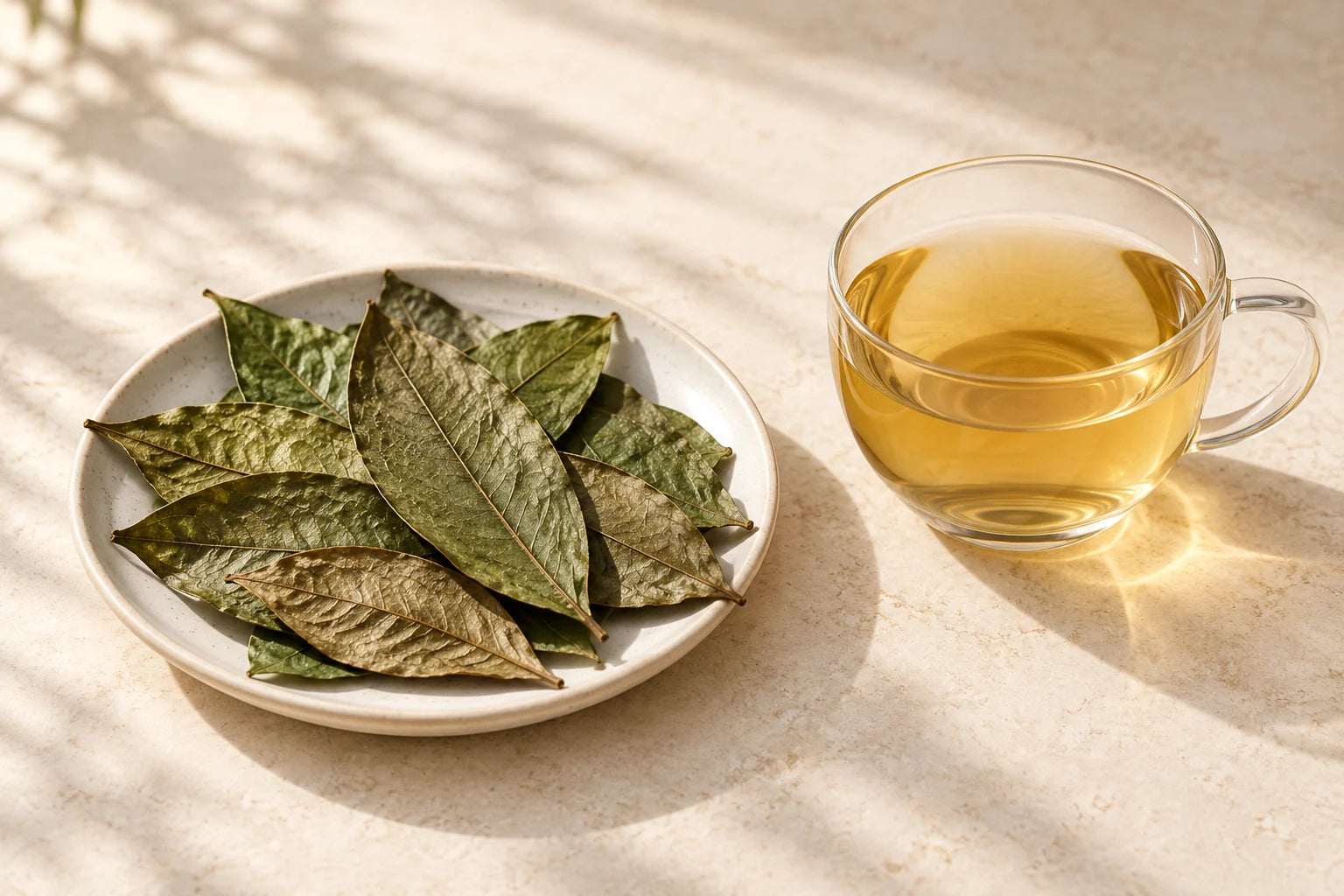
Illustration of dried botanical leaves beside a glass of pale amber infusion
Illustration / ingredient and infusion

A dried ingredient contains compounds that may transfer into water during brewing. How much transfers depends on the compound and the preparation.[4]

The dried leaf tells us about the ingredient. An infusion measurement tells us about the tea prepared from it.

Read: What changes when you brew?

Quality & Testing

How a result
becomes useful.

A useful report identifies the sample, the checks performed and what the measurements mean. These details help you understand which findings apply to your tea.

SAMPLE

What was tested?

METHOD

How was it measured?

RESULT

What can it tell us?

01

Why do laboratories use more than one pesticide test?

Different pesticides need different methods. GC uses gas chromatography; LC uses liquid chromatography. Both separate compounds before MS/MS (tandem mass spectrometry) helps identify and measure them. Together, GC-MS/MS and LC-MS/MS cover a broader range.[7]

02

Why is glyphosate tested separately?

Glyphosate is highly polar, so laboratories use methods suited to its chemistry, such as specialist extraction and LC-MS/MS procedures.[8]

03

What does not detected mean?

Not detected (ND) means the result is below the reporting threshold defined by that laboratory, not necessarily zero. LOD is the detection limit; LOQ is the quantification limit. Check which limit and unit the report uses.[7]

04

Was the test done on dry leaves or brewed tea?

A dry-leaf result describes the ingredient; an infusion result describes a prepared cup. For metals, check the element, sample preparation and unit. Comparing the two also requires the brewing amount, water volume and measured transfer.[4] [9]

05

Moisture, microbes and mycotoxins

Moisture measures water content. Microbiology examines microorganisms. Mycotoxin analysis measures specific toxins produced by certain molds.[10]

06

Organic certification or lab testing?

Certification concerns production and handling requirements. Analysis measures a defined sample. Each supplies a different form of evidence.[11]

Back to page contents

03 / READING THE EVIDENCE

First, ask what
was studied.

Before applying a finding to tea drinking, check what was tested and whether the research involved people. Different study types answer different questions.[5]

01

Laboratory measurements

Chemical analysis identifies or measures selected compounds in a defined sample, such as dried leaves or a prepared infusion.

02

Cell studies

Researchers use cells and controlled assays to explore how substances behave and investigate possible mechanisms.

03

Animal studies

Animal models help researchers examine responses across a whole organism and develop questions for further investigation.

04

Human studies

Human studies examine outcomes in people. Read who took part, the preparation and amount used, the comparison group and the study duration.

Explore selected studies in the Research Library.

See the cited sources

04 / A thoughtful approach

Before you brew.

If you take medicines, are pregnant or breastfeeding, or have a health condition, ask a qualified healthcare professional about the botanical you plan to use.[6]

Published assessments of soursop supplements identify unresolved long-term safety questions.[3]

Soursop tea safety considerations

SOURCES

Behind the numbers.

Numbers in the text link to the original research or guidance. Use this key to see what each source covers.

  1. [1] Butterfly pea colour

    University of Florida IFAS / pigments and acidity.

  2. [2] Roselle calyx chemistry

    Ali et al., Sains Malaysiana (2019) / anthocyanins and phenolic acids.

  3. [3] Soursop supplement safety

    EU-FORA / EFSA Journal (2020).

  4. [4] Soursop leaf extraction, including ultrasound

    Horticulturae 8, 560 (2022) / phenolics, alkaloids, acetogenins and preparation.

  5. [5] Understanding study types

    FDA / laboratory, animal and human research.

  6. [6] Herbal medicine precautions

    NHS Inform / medicines, pregnancy and health conditions.

  7. [7] Methods and reporting limits

    EURL / SANTE guidance (2026).

  8. [8] Highly polar pesticides

    EURL-SRM / QuPPe analytical method.

  9. [9] Elemental analysis

    FDA / Elemental Analysis Manual.

  10. [10] Mycotoxins

    FDA / toxins produced by certain molds.

  11. [11] Organic and residue testing

    USDA / National Organic Program guidance.

  12. [12] Butterfly pea flavonols

    Kazuma et al., Phytochemistry (2003) / petal glycosides.

  13. [13] Roselle organic acids

    Ifie et al., Food Chemistry (2018) / seasonal calyx chemistry.

  14. [14] Soursop alkaloid structures

    Matsushige et al., Chem. Pharm. Bull. (2012) / annonamine from leaves.

  15. [15] Soursop acetogenin structures

    Zeng et al., J. Nat. Prod. (1996) / compounds isolated from leaves.

  16. [16] Ternatin molecular arrangement

    Terahara et al., J. Nat. Prod. (1996) / intramolecular stacking.

  17. [17] Ternatin colour stability

    Terahara et al. (1989) / structural study, neutral solutions.

  18. [18] Roselle flavour chemistry

    Farag et al., Food Res. Int. (2015) / sugars and organic acids.

Back to page contents