
SCIENCE / BREWING
What changes
when you brew?
What leaf size, steeping time and water can change in your cup.
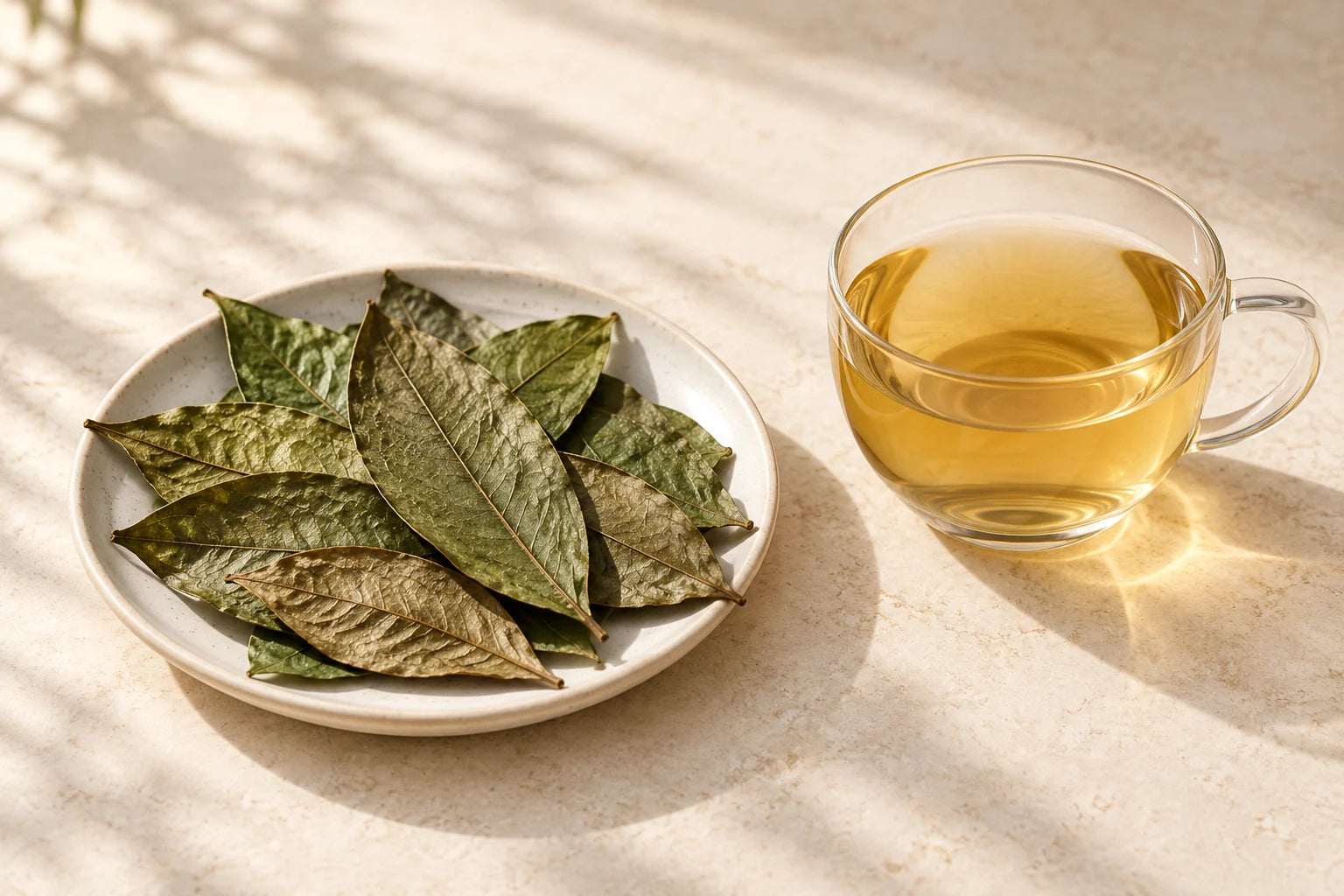
What actually moves from the leaf into the water?
Brewing draws out some compounds, not the whole leaf. Researchers have measured polyphenols, including flavonoids and tannins, in soursop leaf infusions. These are naturally occurring plant compounds. What appears in the brewed tea depends on both the leaves and the preparation. [1]
Does a longer steep always extract more?
In one soursop study, longer steeping increased the measured polyphenols in leaves from one growing region, but the same steady increase was not seen in leaves from another. In other words, the result depended on the leaves as well as the brewing time. A longer steep does not automatically make a better cup. [1]
Why can whole and cut leaves brew differently?
Leaf size changes how quickly water reaches the inside. Cutting leaves exposes more edges. In green-tea research, broken leaves released aroma compounds faster during the early part of brewing than whole leaves. That helps explain why different tea formats can need different preparation instructions. [2]
Is darker tea necessarily stronger?
Colour is not a reliable score for what is in your cup. Water can change a tea’s colour as well as its chemistry. In a green-tea study, harder water produced more browning while some measured polyphenols decreased. A darker cup does not automatically mean more of those compounds. [3]
Comparing laboratory results
Check the sample, brewing method and unit. A result per kilogram of dried leaves cannot be read as the amount in a cup. A brewed-tea result depends on the leaf amount, water volume and preparation used.
These laboratory findings do not establish health benefits or a safe drinking amount, and are not tests of PUREXA products.
For your everyday cup, follow the product’s brewing instructions.
How to prepare soursop teaSources
Agronomía Colombiana (2022). DOI: 10.15446/agron.colomb.v40n2.102621. Soursop samples from two regions; not PUREXA products.
Sánchez-López and colleagues (2020). DOI: 10.1002/ffj.3571. Green-tea research, not a soursop study.
Molecules (2021), 26(12), 3485. Green-tea research, not a soursop study.